TL;DR Quick Answer
Most households pay between $2,400 and $8,200 to move from Toronto to Calgary in 2026. The number depends almost entirely on which of three methods you choose:
- DIY truck rental (U-Haul, Penske): $2,800 to $5,500 all-in (rental, fuel, hotels, equipment, help)
- Moving container (BigSteelBox, PODS): $3,500 to $7,500 for a 16-ft or 20-ft unit, door to door
- Full-service movers, 1-bedroom: $2,400 to $3,400
- Full-service movers, 2-bedroom: $3,600 to $6,000
- Full-service movers, 3+ bedrooms: $5,500 to $8,200, with larger homes reaching $10,000+
The 3,400-kilometre distance changes everything about how this move is priced. Hourly billing disappears. Weight, volume, and route capacity take over. Container shipping closes the gap with full-service movers more than on any shorter route.
Booking 6 to 8 weeks ahead lands the best price and the right crew.
You’ve decided to make the move from Toronto to Calgary. Maybe it’s a job offer, a cheaper mortgage, or simply being done with $3,200-a-month rent on a 600-square-foot apartment. The next question is the practical one: what’s this actually going to cost?
Quotes on this route range from under $2,000 (a DIY truck on paper) to over $12,000 (a full-service corporate move with packing). That’s not gouging.
Toronto to Calgary isn’t one move. It’s three completely different ways of getting the same furniture across four provinces, and the gap between them is the biggest reason quotes look so inconsistent.
This guide breaks down what each of those three options actually costs in 2026, where the hidden charges sit, and how to pick the right one for your move. Numbers come from current Canadian moving industry pricing, Statistics Canada migration data, and the long-distance routes our Kams Movers crews run out of the GTA every week.
How Far Is the Move and Why Distance Changes Everything
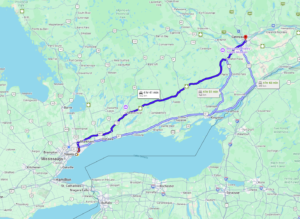
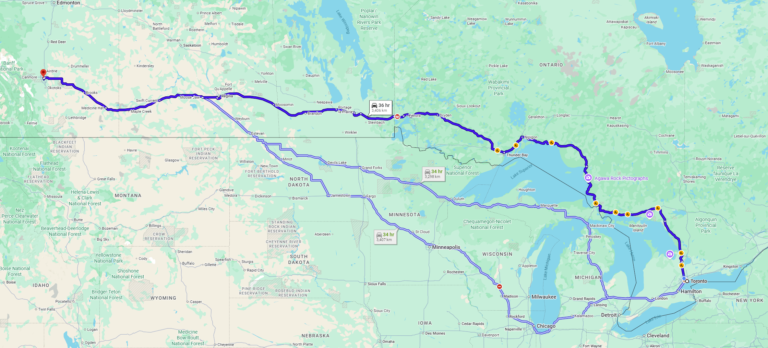
The driving distance from Toronto to Calgary is roughly 3,400 kilometres, depending on route, with 34 to 38 hours of driving time spread across at least three provinces. In a loaded moving truck, that translates to a two or three-day journey one way, with overnight stops typically in Thunder Bay, Winnipeg, and Regina or Medicine Hat.
Distance changes the pricing model entirely. A local Toronto move is billed by the hour. A move under 500 km usually gets a flat distance rate. Past 2,000 km, the model flips to weight, volume, or a flat cross-country rate, with fuel surcharges, mandatory overnight crew costs, and route-specific premiums layered in.
According to BigSteelBox’s 2026 moving cost research, the average 20-foot container-style move carries about 7,500 pounds of contents. That weight, multiplied by Canadian long-haul trucking rates, is what produces the $4,000 to $8,000 quotes you’ll see for typical households on this corridor.
The upside: Toronto to Calgary is one of Canada’s most heavily travelled moving corridors, which keeps prices more competitive than you’d expect for the kilometres involved.
Why So Many Torontonians Are Moving to Calgary Right Now
This isn’t a small trend. According to Statistics Canada data reported by CBC News, Alberta has been the top destination for Canadians moving within the country for twelve straight quarters, three full years running. In Q2 2025 alone, 8,780 Ontarians moved to Alberta versus 5,793 Albertans coming the other way, a net gain of nearly 3,000 people in a single three-month window. Ontario has posted the largest net loss of interprovincial migrants for fifteen straight quarters.
For your moving cost, this matters in a way most cost guides skip. Because so many trucks and containers are heading west with light loads, moving companies routinely have backhaul capacity available on the Toronto-to-Calgary leg. If your dates have flexibility, shared-load or consolidated shipping on this route can cut 15 to 25% off a full-service quote. It’s one of the only Canadian corridors where the migration imbalance actually works in the customer’s favour.
The Three Ways to Move Toronto to Calgary
Most cost guides bury this comparison three sections deep. We’re putting it up front because it’s the single decision that determines almost everything else about your final bill.
Full-Service Movers: Highest Cost, Lowest Effort
A professional crew loads in Toronto, drives the 3,400 km, and unloads in Calgary. You don’t lift a box if you don’t want to. Most long-distance movers on this corridor price one of two ways: weight or volume-based quotes that multiply your shipment’s cubic feet or pounds by a per-unit rate, or flat-rate distance pricing that bundles labour, kilometres, and fuel into a single all-in number.
According to MoveAdvisor’s 2026 route data, full-service pricing typically lands between $2,485 and $7,100, with one-bedroom moves in the $1,864 to $2,858 range and four-bedroom homes reaching $4,970 to $8,165.
Full service makes the most sense if you have a 2-bedroom or larger home, fragile or heavy items, limited time off work, or a non-flexible arrival date. Our long distance moving service handles the full cycle on this corridor, from packing to delivery.
Moving Containers: The Cross-Country Sweet Spot
Companies like BigSteelBox and PODS drop a 16 or 20-foot container at your Toronto home. You load it on your own schedule (sometimes a week or more), they truck it to Calgary, and you unload at your pace on the other end.
The pricing model is fundamentally different. Container companies quote an all-in monthly rental rate that includes delivery, transport, and one month of storage at each end. BigSteelBox publicly states that for households with 2 or more bedrooms, container shipping runs 20 to 40% less than full-service moving. For Toronto to Calgary in 2026, expect $3,500 to $7,500 for a 20-foot container, with most 2 and 3-bedroom households landing between $4,200 and $5,800.
The trade-off is labour: you’re packing and loading on both ends. If you don’t have the time or the body for that, the savings disappear when you hire labour-only crews at $200 to $400 per end. Containers also struggle in two specific situations: downtown Toronto highrises with no legal place to drop a steel box, and Calgary inner-city neighbourhoods (Beltline, Mission, parts of Bridgeland) where street width and parking permits become an issue.
DIY Truck Rental: Cheapest on Paper, Brutal in Practice
U-Haul, Penske, and Discount all rent one-way trucks from Toronto to Calgary. The rental sticker price looks great. The real total almost never does.
A 26-foot U-Haul one-way from Toronto to Calgary in 2026 typically lists for $2,400 to $3,800 for the rental alone, depending on season and day. One-way pricing reflects truck imbalance between cities, and Ontario-to-Alberta is the high-demand direction, which pushes rates up. That’s just the truck. Then add:
- Fuel: a 26-ft loaded truck burns 5 to 7 km per litre. At 3,400 km, that’s 485 to 680 litres. At $1.50 per litre, $720 to $1,020.
- Hotels: three nights at $140 to $200 per night = $420 to $600.
- Meals on the road: $200 to $400 over three days.
- Moving equipment: dollies, straps, blankets, $120 to $200.
- Labour-only help: $200 to $400 per end if you can’t do it solo.
- Damage coverage: base rental insurance is thin. Real protection adds $200 to $400.
The “$2,800 rental” becomes a $4,500 to $6,000 real-world DIY move by the time you turn the keys in at the Calgary lot. Still cheaper than full-service for larger homes, but not by nearly as much as the sticker suggests, and you’re also signing up to drive a 26-foot truck through three days of weather and northern Ontario stretches where the next gas station might be two hours away.
Full Cost Breakdown: All Three Options Side by Side
Here’s what real 2026 households pay across all three methods, sorted by home size. These are out-the-door numbers including labour, transport, fuel, basic insurance, and standard equipment.
| Home size | DIY truck rental (real total) | Moving container | Full-service movers |
| Studio or 1-bedroom | $2,800 to $4,000 | $3,500 to $4,500 | $2,400 to $3,400 |
| 2-bedroom apartment or condo | $3,500 to $4,800 | $4,200 to $5,500 | $3,600 to $5,200 |
| 2-bedroom house | $4,000 to $5,200 | $4,500 to $6,000 | $4,800 to $6,500 |
| 3-bedroom house | $4,500 to $5,800 | $5,200 to $6,800 | $5,500 to $7,500 |
| 4+ bedroom house | $5,200 to $6,500 | $6,200 to $7,800 | $7,000 to $10,000+ |
Prices are 2026 Canadian averages, before tax. DIY totals include rental, fuel, three nights of accommodation, meals, equipment, and basic damage coverage. Container prices assume a single 20-ft unit with one month of rental. Full-service includes packing materials but not full packing labour. Sources: MoveAdvisor 2026 route data, BigSteelBox 2026 pricing resources, U-Haul published rates, and Kams Movers internal data.
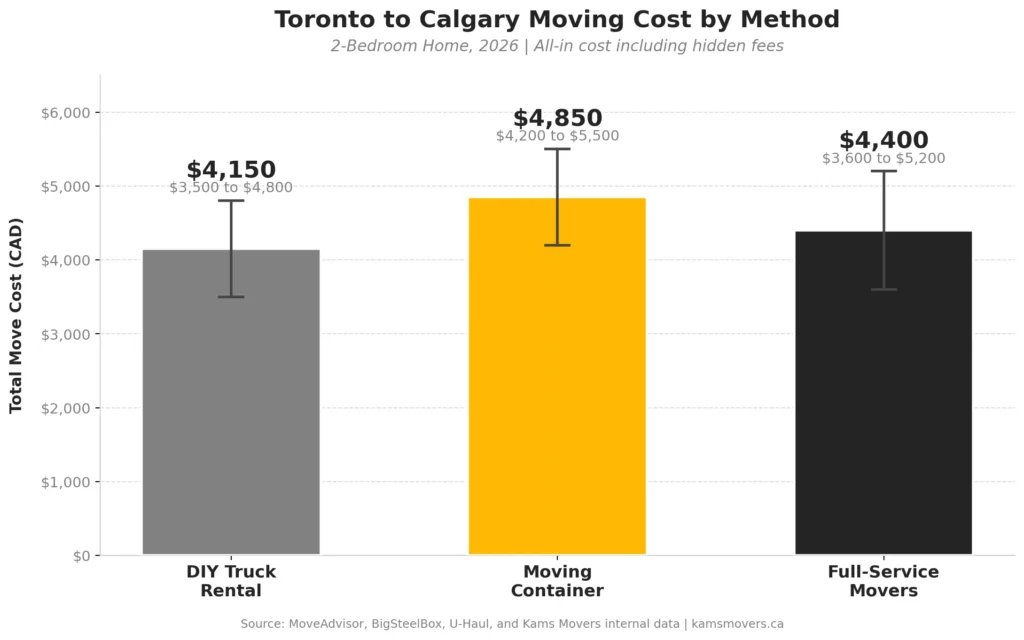
The takeaway: for a typical 2-bedroom move, all three methods cluster in the $3,600 to $5,500 range. The price gap between them is real but smaller than most people assume. The bigger difference is how much of your own time and effort you trade for each dollar saved.
“On the Toronto-to-Calgary corridor specifically, we see most clients choose full-service or container over DIY, and the reason is rarely cost. It’s the three-day drive. People underestimate what it’s like to spend that long behind the wheel of a 26-foot truck, alone, through a Northern Ontario winter. The cost difference between renting a U-Haul and hiring a crew often comes down to less than $1,000 once you tally fuel, hotels, and your own time. That’s not the saving people thought they were getting.”
— Kams Movers Operations Team, 2026
8 Factors That Change Your Toronto-to-Calgary Cost
Two households with identical 2-bedroom apartments can get wildly different quotes on this route. Here’s why.
| Factor | Typical impact on price |
| Total weight or volume of belongings | Up to $4,500 difference |
| Peak season (May to August) | +25% to +50% |
| Stairs (per flight, no elevator) | +$60 to $180 per flight |
| Long carry (truck parks 25+ m from door) | +$100 to $250 per end |
| Heavy or specialty items (piano, safe, pool table) | +$100 to $600 each |
| Full packing service | +$600 to $1,800 |
| Elevator reservation fees (condos, both ends) | +$75 to $150 each |
| Storage between homes | +$180 to $450 per month |
The two that catch most people off guard on this route are weight and packing labour.
Long-distance pricing is calculated on what you’re shipping, not on the kilometres.
Every box you don’t bring saves $50 to $120.
Full packing service sounds convenient until you see it adds the price of a vacation onto the bottom of your invoice.
For specialty items, our piano moving and pool table moving services bundle the specialty charge into the long-distance quote, so it’s transparent rather than a line item added at the end.
When to Move and How Much You Can Save by Timing It Right
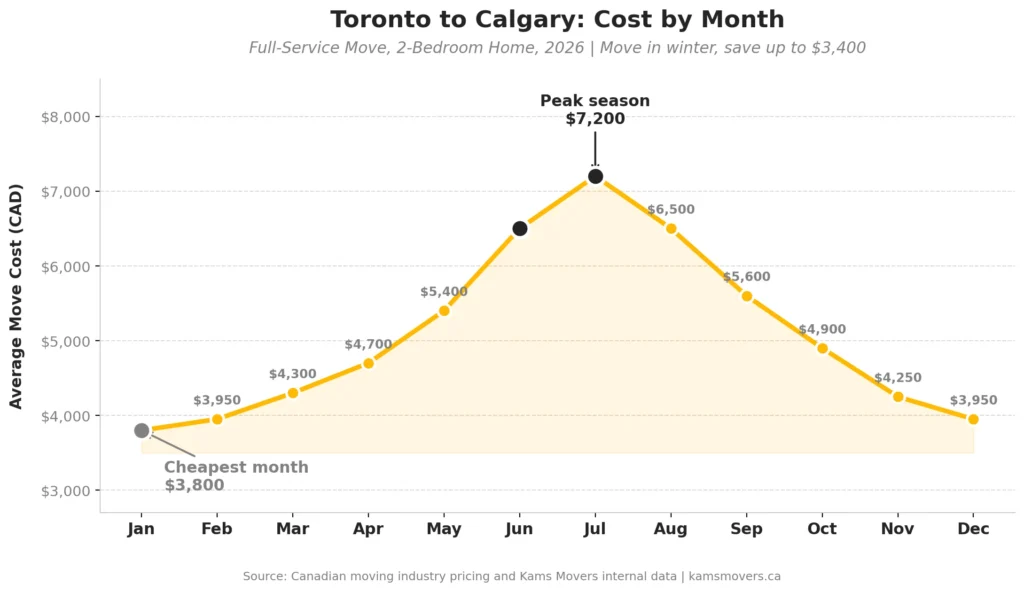
The Toronto-to-Calgary corridor follows the standard Canadian seasonal pricing curve, with one wrinkle: summer demand is even steeper here than on shorter routes because the cross-country migration peaks alongside the regular moving season.
The Cheapest Times to Move from Toronto to Calgary
- Mid-January to early March: The lowest prices of the year, often 25 to 35% below summer rates. Winter driving across Northern Ontario and the prairies is the trade-off.
- Mid-October to late November: Real estate slows, summer demand fades, and weather is still manageable through most of the route.
- Mid-week, mid-month: Tuesday on the 17th will beat Saturday on the 1st by 10 to 15%.
- Any date that isn’t late June through early August: Cross-country corporate relocations and the end-of-school-year family migration push summer rates to their annual peak.
Based on Kams Movers internal data and broader Canadian moving industry pricing, winter Toronto-to-Calgary moves average $4,000 to $6,000, while summer moves on the same route climb to $6,000 to $8,500.
That’s a $2,000 spread on the exact same furniture going to the exact same address.
The Hidden Costs of Cross-Country Moving
This is where the gap between the initial quote and the final invoice gets wide. These charges are legal and standard, but only some movers tell you about them upfront.
Fuel surcharges
Most long-distance companies layer a 5 to 12% fuel surcharge onto the base quote, calculated against the current diesel index.
On a $5,500 base, that’s $275 to $660 you didn’t see in the headline number. Ask whether your quote is “fuel-inclusive.”
Mandatory overnight costs
A 3,400 km move can’t be done in a single shift.
Movers either bill driver overnight stays and per diems into the base quote, or list them as add-ons.
Confirm which one is happening on your invoice before you sign.
Stairs and long carries
Toronto condo with no freight elevator? Calgary inner-city walk-up? Each flight typically adds $60 to $180.
If the truck can’t park within 25 metres of either door, expect a long-carry fee of $100 to $250 per end.
Specialty items
Pianos, gun safes, pool tables, and large appliances usually carry a flat surcharge of $100 to $600 per item because they need extra crew, equipment, and rigging.
Packing materials and labour
Boxes, tape, bubble wrap, and dish-pack barrels for a 2-bedroom home cost $250 to $500 if you buy them yourself.
Having the mover pack for you adds $600 to $1,800. Our packing and moving service bundles both into a single line item, which usually beats booking separately.
Storage between homes
Cross-country move timing rarely lines up perfectly.
If your Calgary home isn’t ready when your Toronto lease ends, expect $180 to $450 per month plus a re-delivery fee.
Our moving and storage service rolls both into one contract to skip the standard double-handling charge.
A Real Toronto-to-Calgary Move: 2026 Invoice Example
The Patel Family Move: Mississauga to Calgary Beltline
Profile: 2-bedroom condo in Mississauga, moving to a 3-bedroom rental in Calgary’s Beltline.
Moving date: February 14, 2026 (mid-week, mid-month, off-peak). 5,400 lbs of belongings. Full-service mover.
| Line item | Cost |
| Base long-distance rate (weight-based) | $3,650 |
| Fuel surcharge (8%) | $292 |
| Mississauga building elevator fee | $75 |
| Stair carry (3 flights, Calgary walk-up) | $180 |
| Packing materials (self-packed except kitchen) | $220 |
| Kitchen packing labour (1 hour, 2 movers) | $180 |
| Basic transit coverage | Included |
| Total before tax | $4,597 |
| HST (Ontario portion, on labour) | $245 |
| Final invoice | $4,842 |
Same move quoted at summer peak (mid-July) would have run an estimated $5,900 to $6,400. The Patels saved roughly $1,200 by moving in February instead of July.
How to Lower Your Toronto-to-Calgary Moving Cost
Some of these save you $100. Stacked together, they can cut $2,000 or more off a typical invoice.
- Move off-season: Mid-January through early March is the cheapest window. A winter cross-country move can run $1,500 to $2,500 less than the identical move in July.
- Pick mid-week, mid-month: Avoiding the first and last days of the month is worth 10 to 15% on its own.
- Declutter aggressively: Long-distance pricing is weight-based or volume-based. Every box you leave behind saves $50 to $120.
- Pack yourself, except for fragiles: Full-service packing adds $600 to $1,800. DIY everything except the kitchen and electronics, and you keep most of that.
- Ask about shared-load or consolidated shipping: Because the Toronto-to-Calgary corridor has so much truck capacity heading west, mixing your load with others can cut 15 to 25% off the bill in exchange for a slightly wider delivery window.
- Get three real quotes, not online calculators: Have movers do a virtual or in-home walk-through. Online estimators consistently underprice this corridor.
- Book 6 to 8 weeks ahead: Late bookings on this route in peak season get whatever capacity is left, which is rarely the best price or the best crew.
When You Should (and Shouldn’t) Choose Each Method
| Choose full-service if… | Choose container if… | Choose DIY if… |
| 2-bedroom home or larger | You want flexibility on loading dates | Studio or 1-bedroom with light furniture |
| Heavy or fragile items (piano, antiques) | You’re okay loading yourself | You have a flexible week and help on both ends |
| Limited time off work | Calgary home not ready immediately | You’re confident driving a 26-ft truck three days |
| You want one company handling everything | Cost matters more than convenience | Off-season move with no time pressure |
| Specialty items or tight timing | You have legal space for a container at both ends | Easy ground-floor access at both homes |
If you’re somewhere in the middle, our long-distance crews on this corridor offer hybrid arrangements: full-service loading and the drive, with self-unloading in Calgary to bring the cost down on the back end.
Frequently Asked Questions
How much does it cost to move from Toronto to Calgary in 2026?
Most households pay between $2,400 and $8,200 to move from Toronto to Calgary in 2026. A 1-bedroom full-service move runs $2,400 to $3,400. A 2-bedroom runs $3,600 to $6,000. A 3-bedroom runs $5,500 to $7,500. Moving containers (BigSteelBox, PODS) cost roughly $3,500 to $7,500 depending on container size. DIY truck rental is $2,800 to $5,500 once fuel, hotels, and equipment are added to the rental.
How long does a Toronto-to-Calgary move take?
The drive is 34 to 38 hours of road time across about 3,400 kilometres, typically completed over 2 to 3 days with overnight stops. Most full-service shipments are delivered within 3 to 7 days of pickup, depending on whether your shipment is on a dedicated or shared-load truck. Shared-load delivery windows are wider, sometimes 5 to 10 days.
What is the cheapest way to move from Toronto to Calgary?
For a 1-bedroom or studio, full-service movers are often the cheapest option once you account for the real cost of DIY (rental, fuel, hotels, meals, and equipment). For 2-bedroom homes and larger, moving containers are typically 20 to 40% cheaper than full-service. DIY truck rental is only meaningfully cheaper if you have minimal belongings and people to help you load and unload on both ends.
Should I rent a U-Haul one-way from Toronto to Calgary?
A one-way rental is feasible but rarely the bargain it looks like. One-way truck rentals are priced by the rental company based on demand imbalance, and because Ontario-to-Alberta is a high-demand westbound corridor, prices run higher than the reverse direction. A 26-foot truck typically lists for $2,400 to $3,800 in 2026. Once you add fuel, three nights of hotels, meals, equipment, and damage coverage, the real total lands at $4,500 to $6,000. That’s close to or above what a full-service mover would charge for a small home.
When is the cheapest time to move from Toronto to Calgary?
Mid-January through early March offers the lowest prices, often 25 to 35% below summer peak rates. The second-cheapest window is mid-October through late November. Mid-week and mid-month dates always beat first-of-month or weekend dates. Avoiding late June through early August is the single biggest seasonal saving.
How far in advance should I book a Toronto-to-Calgary move?
Book 6 to 8 weeks ahead for peak season (May through August) and at least 3 to 4 weeks for off-season moves. Cross-country routes have limited capacity, especially for specific delivery dates. Late bookings during summer get whatever is left, which is rarely the best price.
Are moving costs from Toronto to Calgary tax-deductible?
Sometimes. If you’re moving at least 40 kilometres closer to a new job, business, or full-time school, the Canada Revenue Agency lets you deduct eligible moving expenses on your tax return. A Toronto-to-Calgary move easily clears the 40 km test. Keep your moving invoice, fuel receipts, and accommodation receipts, and confirm details with a tax professional or the latest CRA moving expenses guidance.